MTB forks: 26, 27.5 and 29-inch


Starting at €403.00
€393.00


Replacing your MTB forks means respecting four measurements: wheel diameter, the travel your frame is designed for, the steerer and the wheel axle. Air and coil spring suspension forks, from cross-country to downhill, rigid forks and fork spare parts are brought together on this page.
How does an MTB fork work: what is it made of?
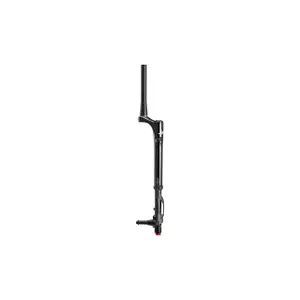
A suspension fork combines two assemblies that slide into each other. At the top, the steerer tube passes through the frame's head tube and takes the stem; it is fixed to the crown, the part that connects the two stanchions. These upper tubes, polished or surface-treated, slide into the lowers, the lower assembly joined by an arch and ending in the dropouts that take the wheel axle. On most models, one leg houses the spring and the other the hydraulic damper cartridge, with its adjustment dials at the top and the rebound adjuster at the bottom. Downhill forks use a dual crown, which clamps the stanchions above and below the head tube.
How much travel for your riding?
- Cross-country: 100 to 120 mm, for a light fork that stays efficient on climbs, such as the RockShox SID or the Manitou R7.
- Trail: 120 to 150 mm, the most versatile compromise.
- Enduro: 150 to 180 mm, with 35 to 38 mm stanchions for stiffness, such as the RockShox Lyrik or ZEB.
- Downhill: about 200 mm on a dual crown fork, such as the RockShox Boxxer or the Fox 40.
- Dirt jump and street: 80 to 100 mm, on short, robust forks such as the Manitou Circus.
Stay within the travel range specified by your frame manufacturer: a few extra centimetres raise the front end, slacken the head angle and change how the bike handles. Rigid forks, without suspension, remain a simple, light option for touring mountain bikes, loaded bikes and fat bikes.
Wheel size, axle and offset: the compatibility measurements
Each fork is designed for one wheel diameter: 26, 27.5 or 29-inch. Some, marked 27.5+/29, accept a 29-inch wheel or a 27.5-inch wheel with wide tyres. The axle must match your front hub: a 9 mm quick release on simpler models, a 15x100 mm thru-axle, 15x110 mm for the Boost standard or 20x110 mm on downhill forks. The offset, marked OS in model names, for example 44 or 51 mm, moves the wheel axle forward of the steering axis: it affects the stability and liveliness of the steering and is chosen according to your frame's geometry. For the brake, most forks take a post mount calliper, with a minimum rotor diameter; entry-level models sometimes keep bosses for V-brakes.
Straight, tapered or threaded steerer?
The steerer must match the frame's head tube. A tapered steerer, 1 1/8-inch at the top and 1.5-inch at the base, marked 1.5T or tapered, is found on most modern mountain bikes. A straight 1 1/8-inch steerer, or 28.6 mm, is found on older or entry-level frames. A threaded 1-inch steerer, held by a threaded headset with a locknut, now only concerns older bikes. A new fork comes with a long steerer, to be cut to the right height taking into account the headset, spacers and stem: a cut that is too short cannot be undone.
Air or coil spring, damping: what are the differences?
The air spring, the most widespread, is set with a high-pressure shock pump according to your weight, and its progression is adjusted with volume spacers. The steel coil spring offers great sensitivity over small bumps but is heavier and is changed according to your weight. On the damping side, rebound sets the speed at which the fork extends, compression its firmness as it compresses; the lockout, sometimes operated from the handlebar, firms it up for road climbs. The markings RL, RC or RC2 and RMT, for a remote lockout, indicate these adjustments in model names.
Headset, stem and other components
A new fork often means checking the steering: the headset must match the steerer and the frame, with a crown race suited to the diameter at the base of the steerer. The MTB stem clamps onto the steerer, and a wider or higher-rise handlebar often goes with a longer-travel fork. For a bike with 20-inch wheels, BMX forks have their own page, and our full range of MTB components completes your set-up.
Which MTB fork brands to choose?
RockShox, which produced one of the first mountain bike suspension forks before joining the SRAM group, covers the whole range: Judy and SID for cross-country, Lyrik and ZEB for enduro, the dual crown Boxxer for downhill.
Zoom, the brand of the Chinese manufacturer HL Corp, which also produces stems and seatposts, offers spring forks for leisure mountain bikes and hybrids, such as the Forgo 565 or the Vaxa, often with a handlebar lockout.
Manitou, an American brand in the Hayes group, offers the R7 for cross-country, the Mattoc and the Mezzer for trail and enduro, the dual crown Dorado for downhill and the Circus, a dirt jump benchmark.
Suntour, which became SR Suntour after taking over the name of the Japanese manufacturer SunTour, produces its forks in Taiwan and China and offers the Axon for cross-country, the Zeron and the Raidon for trail and the Durolux for enduro.
Fox names its forks after their stanchion diameter: 32 and 34 for cross-country and trail, 36 and 38 for all mountain and enduro, the dual crown 40 for downhill; Factory versions receive a Kashima coating.
Cannondale offers the Lefty, a single-leg fork running on needle bearings: Ocho for cross-country, Oliver for gravel. It requires a specific front hub.
MTB forks on sale: clearance and key events
Forks from previous ranges move to our MTB components clearance, and new references to new arrivals. Black Friday is a good time for a part this important, best prepared by noting your frame's measurements in advance.
Frequently asked questions
Can you fit a fork with more travel?
Within the limit specified by the frame manufacturer. A longer fork raises the front end and the bottom bracket and slackens the head angle: the bike gains stability on descents but loses liveliness and climbing efficiency. Beyond the intended range, the frame is subjected to forces it was not designed for.
How do you set the pressure in an air fork?
Start from the chart printed on some lowers or published by the manufacturer, which matches a pressure to your riding weight, then inflate with a high-pressure shock pump. Next, check the static compression, or sag, in position on the bike: the O-ring on the stanchion shows the travel used. Finally, set the rebound so that the fork returns quickly without bouncing.
How should you maintain an MTB fork?
Wipe the stanchions after every ride and check that they are neither scratched nor marked. Manufacturers specify a lower leg service, seals and oil, at regular intervals expressed in hours of riding, and a full damper service less often. Play in the lowers or an oil leak signals that a service is due.
How do you measure your fork's steerer?
Measure the diameter at the top of the steerer, 28.6 mm for 1 1/8-inch, then at the base, near the crown: 38.1 mm on a 1.5-inch tapered steerer. The length is measured from the crown race seat to the top of the steerer; compare it with the combined height of the head tube, headset, spacers and stem.
Does a 27.5-inch fork accept a 29-inch wheel?
Usually not: the tyre would rub against the arch. Only forks stated as 27.5+/29 compatible accept both diameters, within the permitted tyre width. The reverse, a 27.5-inch wheel in a 29-inch fork, lowers the front end and alters the bike's geometry.