MTB platforms Black Friday: single and double deals
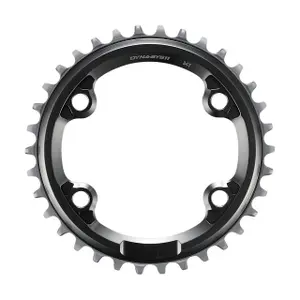


Starting at €49.99
€43.03


Starting at €41.49
€32.62


A mountain bike chainring bought on Black Friday must first fit your crankset: check its attachment, four arms with their measurement in millimetres or direct mount, then the number of speeds and teeth you want. Vélo-Store applies discounts throughout November on a large part of this selection, which includes single chainrings, double and triple chainrings, and models for electric mountain bike motors.
What to consider before choosing a mountain bike chainring
A chainring isn't just about the number of teeth: it attaches to a specific crankset. Start by checking the reference of your crank arms, usually printed on their inner face. Then note the type of attachment. A four-bolt chainring can be identified by its screws and its measurement, the diameter of the circle that passes through their centre, most often 104 mm for mountain bikes. A direct mount chainring attaches without a spider and only exists for a specific interface: Shimano, Sram, Cinch with Race Face or electric bike motor. Finally, consider the number of speeds, which affects the thickness of the teeth.
Read a chainring specification in just a few seconds
The name of the product tells you the essentials. "104x36T" indicates the attachment measurement followed by the number of teeth. "DM" signifies a direct mount, and with Sram, the note "3 mm offset Boost" or "6 mm" indicates how much the chainring is shifted towards the frame: it needs to match exactly, or it will affect the chain line. "1x12V" refers to a single chainring for a 12-speed drivetrain, and "Narrow Wide" describes an alternating tooth profile that keeps the chain in place without a front derailleur. For double or triple setups, the specification also indicates the position: inner, middle, or outer.
Discounted chainrings: compare what can be compared
With equal measurement and number of teeth, two chainrings can still be very different. An original chainring matches exactly the profile specified by the group manufacturer, while an adaptable chainring is designed to fit several cranksets and indicates which ones. An oval chainring and a round chainring provide different pedalling sensations. On an electric mountain bike, some versions include a guard that protects the chain: check the motor generation. With Sram, the X-Sync Eagle comes in both round and oval versions, so the strikethrough price of one doesn't indicate anything about the other: compare the strikethrough price and the displayed price for the same version, including the offset.
Pages to check along with this one
To choose between single, double, and triple, the mountain bike chainrings page details each case throughout the year. A new chainring works poorly with an extended chain: take a look at the mountain bike chains from Black Friday, and at the mountain bike cassettes if you are changing gears. Double chainrings require an appropriate front derailleur, and the mountain bike drivetrain on Black Friday gathers the rest. The clearance section features end-of-line products all year round, and the new arrivals lists the latest references received.
Mountain bike chainring brands in the promotion
Shimano labels its replacement chainrings with a reference SM-CRM, such as the SM-CRM85 for Deore XT and the SM-CRM95 for XTR in direct mount 12-speed, as well as those from its four-bolt cranksets.
FSA includes the attachment measurement and the number of teeth in the name of its chainrings, making comparison easier; its Megatooth range includes models for Bosch motors.
Specialités T.A., a French manufacturer of chainrings, offers its One range in direct mount for Shimano, Sram, and Race Face, and its Ovalution range in oval chainrings with four bolts.
Sram offers its X-Sync Eagle chainrings in direct mount with 3 or 6 mm offsets, available in round or oval versions.
Stronglight, a manufacturer from the Saint-Étienne region, produces single chainrings in 7075 aluminium, including models for Yamaha motors with a guard.
Race Face designs chainrings for the Cinch interface of its crank arms and single Narrow Wide chainrings in 104 mm.
Frequently asked questions
When does Black Friday start?
Black Friday refers to the day after Thanksgiving, which kicks off the holiday shopping season in the United States. Vélo-Store takes it further: its discounts on mountain bike chainrings run throughout November, organized like the rest of the site.
How can I be sure that a discounted chainring will fit my mountain bike?
Compare its specifications with three pieces of information from your bike: the crank reference, the attachment, and the number of speeds. If not, the measurement and number of teeth are often found on the current chainring.
Single chainring mountain bike: 32 or 34 teeth?
32 teeth is suitable for most trails and keeps gearing easy on climbs. 34 teeth lengthens each pedal stroke, which is useful on flat paths or for a strong rider, but at the cost of harder climbs.
Should I change the chain with the chainring?
An extended chain wears out a new chainring quickly and can skip on its teeth. Measure it with a wear indicator: if it has reached the limit, replace it at the same time.
Can I switch to a single chainring with a simple chainring?
Sometimes, if the crankset can accommodate a single chainring with alternating teeth in its attachment. You also need to remove the front derailleur and its shifter, and check that the cassette has enough range for your climbs.