Expander and steering play tool


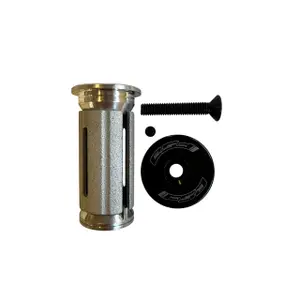


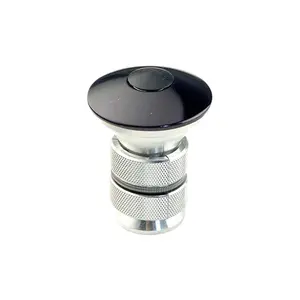


A steering stem expander slips into the stem of the fork and serves as a support for the cap screw that puts the steering under tension; it is the recommended part for carbon stems, where an aluminum stem receives a star. This page also includes the star installation tool, cone tools, and spacers.
Star or expander: what are they for?
On a non-threaded steerer, the stem tightens around the steerer, and the top cap screw pulls the stem down to eliminate play in the bearings. This screw needs a point of support in the steerer. The star, a clamped washer inserted into the tube, plays this role in aluminium or steel steerers. The expander, a cap that expands when tightened, supports without marking the tube: carbon fork manufacturers require it, as the claws of a star can cut into the fibres.
Choosing a steerer expander
The expander must match the internal diameter of the steerer, which depends on the external diameter, often 1 inch 1/8 at the top of the fork, and the wall thickness. A short model is suitable for cut flush steerers. Follow the specified torque and the fork manufacturer's instructions, which sometimes require a spacer above the stem.
Fitting a star, a cone, bearing cups: assembly tools
The star should be inserted straight and to the right depth, about 15 mm below the top of the steerer, using a fitting tool that guides it; if installed at an angle, it won't hold tension. The fork cone, the ring that holds the lower bearing, is pressed all the way onto the shoulder with a cone punch and removed with a puller. The pressed-in cups are installed with a press, found in the bottom bracket tools when it serves both. To mill or ream a steerer tube, check the frame tools.
Shim spacers: adjusting handlebar height
Shim washers, or spacers, are placed under or above the stem to adjust the height of the cockpit without cutting the steerer. The top of the steerer should remain a few millimetres below the top of the stem so that the cap tensions the steerer correctly. The torque wrenches are gathered in the hex wrenches, all the tools in the bike tools; also think about clearing stock and the new arrivals.
Which brands of steering tools to choose?
FSA, which prohibits the star in carbon steerers, offers its expanders for steerer of 1 inch 1/8, including a model with a diameter of 23 mm.
Granite Design houses a multi-tool in the steerer of the fork with the Stash, available for straight or tapered steerer, ratcheting in the RT version and with its own expander in the RCX version.
Pro, component brand of the Shimano group, offers its expanders in a short version or with a carbon cap.
Cyclus provides the star fitting tool and a tool for the steering cone, to be used with its reference tool 180023.
Frequently asked questions
Can you put a star in a carbon steerer?
No. The claws of the star can cut into the fibres and weaken the steerer until it breaks. Use the expander specified by the fork manufacturer, or a compatible model with the internal diameter of the steerer.
How to remove a steering star?
It is not designed to come out easily. To install a new one, push the old one further down the steerer with a pin punch, or remove it from the bottom of the fork, before fitting the new one with the installation tool.
Is a press needed to fit a headset?
For cups pressed into the steerer tube, yes: the press seats them straight. On an integrated headset, the bearings simply fit into the frame's housings without a press, and only the fork cone requires a tool.
How many washers can you put under the stem?
The limit is set by the fork manufacturer and is stated in their instructions. If the desired position exceeds this, a higher stem is preferable to a stack of washers.
Does an expander loosen over time?
Not if properly tightened. A reappearing play is more often due to a poorly tightened stem or a steerer protruding from the stem. Check the expander's torque and the headset's adjustment.